
I am obsessed with my appearance. I invest time, energy, money, and creativity to look a certain way. I sometimes stare at myself in the mirror. I look at group photos and zoom in on myself. Strictly speaking, this is not uncommon. (If you don’t do it, you’re either lying or perfect.) Every day, society tells us we should look a certain way. On top of that, runners experience unique messaging: be like the pros we follow on social media, emulate Fiona O’Keefe’s double-braid hair style, be lean, leggy, and decked out in split shorts or bulky watches.
To many of us, running is more than a hobby, it’s a community and a lifelong passion. People tailor appearances to their community and passions all the time. If we imagine running to be a subculture, it’s no wonder there’s been a consensus in how we present ourselves. We signal to fellow runners and non runners alike our values, how we spend our time, and who we spend it with. This type of signaling, compounded by messaging from sponsored runners and running brands brings the Swimmer’s Body Fallacy out of the water and onto the track: in order to enjoy and be good at this activity, you have to look a certain way. Having visual membership to a community can be a wonderful thing, yet when I curate my appearance that I am so obsessed with, I make it a point to not fit in.
I direct my energy into showing up visibly queer when I’m on the track. Marrying these two worlds leaves me straddling two identities. I often ask myself why is it so important that I am visibly queer in my running? My answer lies in the joy I get when I train and race and in the vulnerability and meaning I create when I bring my whole self into that experience.
Queerness has its own visual subculture. From signaling queerness through hanky code, decentering the opposite gender, gender transition, and showing up in places designed for heterosexual partnerships with a same-gender partner, the history of queer presentation demonstrates a physical presentation is often at odds with the norm.
Standing out leaves a person in a powerfully vulnerable position. Competing individually, chasing my limits in front of competitors, coaches, and other athletes, I often feel exposed and alone in my suffering– no time outs, no catching my breath. I am alone, and paradoxically surrounded by others who must be having the same experience. The beauty of racing is that it transforms tough, isolating moments into an expression of power, confidence, and authenticity. I become emboldened while using my body to compete. For me, physically expressing my queerness on the track is part of that powerful yet vulnerable experience. The intersection of my queer and athletic identities have shown me that being self-assured in one’s dissonant experience isn’t a disadvantage, it’s a powerful tool.
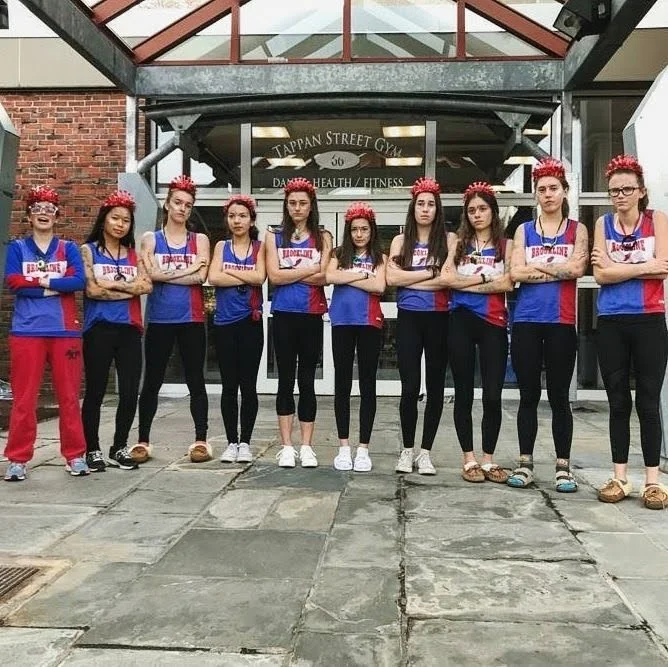
Younger Daf, (far left) queering up her High School team’s spirit
